
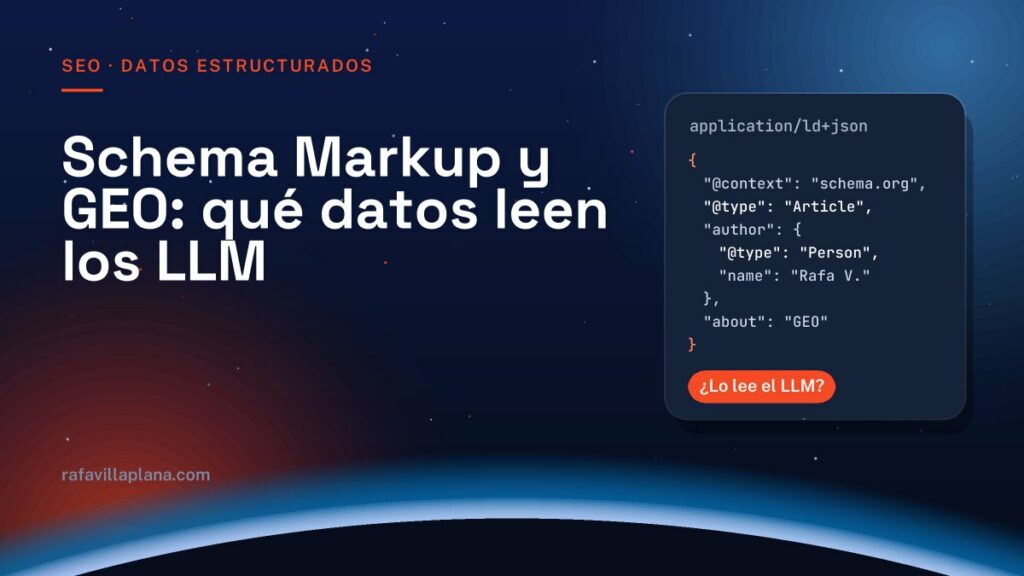
The data doesn’t show that schema markup makes ChatGPT, Gemini or Google’s AI Overviews cite you more. I’ll say it up front because it’s one of the most repeated false promises right now: “add schema so AI cites you”. The only published causal experiment found no improvement, live reading tests show that LLMs ignore hidden JSON-LD, and Google states in writing that no special markup is needed for its AI features. That said, schema is still worth having, just for other reasons. Here’s what they are, with the data to back it up.
What schema markup is
Structured data is a standardised way of telling machines what a page contains: that it’s a recipe, a product with a price, an article with an author or a business with an address. The standard vocabulary is Schema.org (created in 2011 by Google, Microsoft, Yahoo and Yandex), and the recommended format is JSON-LD, a block of code in the page’s <head>.
It was designed for two things: helping search engines understand content without ambiguity, and letting them display it as a rich result (stars, prices, breadcrumbs). It wasn’t designed for LLMs. That nuance is the source of all the confusion.
The key question: does schema make AI cite you more?
Ahrefs’ causal study (May 2026). It’s the best evidence available, and its design is solid: they tracked 1,885 pages that added JSON-LD and compared them with 4,000 control pages with similar citation levels, measuring 30 days before and after. The result:
| Platform | Effect vs. controls | Interpretation |
|---|---|---|
| Google AI Mode | +2.4% | Indistinguishable from zero |
| ChatGPT | +2.2% | Indistinguishable from zero |
| Google AI Overviews | −4.6% | A small drop that can’t be confidently attributed to schema |
Ahrefs’ conclusion: schema had no clear effect, either positive or negative. In raw terms, the pages with schema grew 43% in AI Mode… but the control pages grew almost as much. That’s the classic mistake of a success story with no control group.
Why: LLMs read the visible HTML, not the JSON-LD. searchVIU’s experiment (October 2025) built a page with prices placed in 8 different ways and asked five systems to read them. The damning result: the price that only existed in the JSON-LD wasn’t found by any of the five (ChatGPT, Claude, Perplexity, Gemini, AI Mode). Their conclusion: AI chatbots don’t use JSON-LD for direct retrieval; they extract only the visible HTML content.
The correlation that fooled the industry. Before that experiment, people noticed that pages cited by AI were around 3 times more likely to have JSON-LD (53% use it). That figure circulated as proof that “schema gets you cited”. It doesn’t prove that: sites that add schema also invest in technical SEO, content and links. Schema is a marker of well-maintained sites, not the cause of the citation. And now we have the experiment that confirms it.
Google, in writing. Its documentation is explicit: you don’t need to create machine-readable files, AI text files or markup to appear in these features, and there’s no special schema.org structured data you need to add. And in its generative AI guidance, obsessing over structured data is literally listed among the things not to do.
“This is one of the most awkward conversations I have with clients, because someone has sold them schema as their ticket into ChatGPT. And I have to show them the study: 1,885 pages, zero effect. Schema is excellent technical hygiene and I always implement it, but if someone bills it to you as an ‘AI citation lever’, ask for the control group. They won’t have one.” – Rafa Villaplana, SEO consultant and CEO of Linking & Growing
So what is schema still good for in 2026?
Three real, measurable things:
1. Rich results in Google. This is its documented use: product listings, stars, breadcrumbs. Google cites cases with CTR improvements of 25–82% (favourable examples it chose, not averages). That said, the catalogue is shrinking: Google retired FAQ rich results on 7 May 2026, breadcrumbs disappeared on mobile, and HowTo and seven other types were dropped. The ones that matter for business are still active: Product, LocalBusiness, Organization, Article, Event, Recipe.
2. Entity and Knowledge Graph. Organization with sameAs links your brand to its official profiles (LinkedIn, Google Business Profile, Wikidata) and influences the knowledge panel. For authors, Person clarifies who’s writing, an E-E-A-T signal.
3. Indirect understanding. Schema helps Google understand your entity in its index. Since AI Overviews and AI Mode draw on that index, it’s plausible that a well-defined entity helps grounding indirectly. But careful: that’s a reasonable hypothesis, not a proven citation factor. And in ChatGPT or Perplexity, which read pages live, that indirect path doesn’t even exist.
Which structured data to prioritise
- Organization with sameAs, first of all. Entity and knowledge panel.
- Person for authors, for E-E-A-T. But what demonstrates experience is the visible bio; the markup only connects it.
- LocalBusiness (with the most specific subtype, e.g.
ProfessionalService), for local businesses such as a consultant in Valencia. A word of warning: the real local lever for AI is Google Business Profile, more than JSON-LD. - Product/Offer for ecommerce, which enables merchant listings. The price also has to be visible on the page.
- BreadcrumbList, cheap and useful for hierarchy.
- FAQPage: the content yes, the markup is optional. It no longer produces a rich result; what’s valuable for GEO is a visible FAQ in the HTML, with real questions and self-contained answers, which are exactly the passages an LLM extracts.
The nuance that changes everything: write for the visible HTML
If an AI assistant extracts your passages from the visible content, the takeaways for GEO are straightforward:
- Data, prices, opening hours, definitions and figures in the text, not just in the schema.
- Visible FAQs with direct answers in the first few lines.
- Key content in server-rendered HTML (ChatGPT, Claude and Perplexity didn’t execute JavaScript in searchVIU’s test).
- Full consistency between schema and text, which, incidentally, is the only thing Google explicitly asks for regarding structured data in its AI features.
“My rule of thumb: everything you want AI to say about you has to be in the text a human reads. If a piece of information only lives in your JSON-LD, it doesn’t exist for ChatGPT. The schema that counts is the schema that describes what’s already written on the page, not a parallel store of hidden information.” – Rafa Villaplana, SEO consultant and CEO of Linking & Growing
How to validate it, and common mistakes
Validation: Google’s Rich Results Test (eligibility for Google features), the Schema Markup Validator (general Schema.org syntax) and the enhancement reports in Search Console.
Mistakes that cost you dearly:
- Marking up content that isn’t visible. Google explicitly prohibits it and it can lead to a manual action.
- FAQPage or review spam. Made-up FAQs, self-generated stars.
- Types that don’t match (Product for a service, JobPosting with no actual job).
- Outdated data in the schema that contradicts the visible page.
Verdict
Schema markup is SEO hygiene that’s still worth doing: it enables rich results with a documented impact on CTR, defines your entity and is cheap to maintain. It isn’t an AI citation lever: the only causal experiment found no improvement, live reading tests show LLMs ignore JSON-LD, and Google says so in writing.
My recommendation: put schema on your technical checklist, measure its effect on rich results and CTR, and spend your GEO budget on what actually moves citations: visible, extractable content, authority, brand mentions and consistent entity profiles (Google Business Profile included).
Frequently asked questions
Does adding schema make ChatGPT or Google’s AI cite me more?
Not according to the data. Ahrefs’ causal study of 1,885 pages found no significant improvement in citations after adding JSON-LD, and live reading experiments show that LLMs extract the visible HTML, not hidden markup.
So should I remove schema from my website?
No. It’s still valuable for Google’s rich results (stars, prices, listings) and for defining your entity in the Knowledge Graph. It’s SEO hygiene, just not an AI visibility tactic.
Does FAQPage schema help AI cite me?
FAQPage markup no longer produces a rich result in Google (retired in May 2026). What does help with GEO is having your FAQs visible in the HTML, with direct answers: that creates passages AI can extract. The markup itself is optional.
Which schema should a local business prioritise?
Organization with sameAs, and LocalBusiness with the right subtype (with data matching the website). But for local visibility in AI, the strongest lever is a well-optimised Google Business Profile, more than JSON-LD.
Why did people say schema helped if it doesn’t?
Because of a correlation: pages cited by AI had schema more often. But those sites also invest in everything else (content, links, technical SEO). Schema marks well-maintained sites; it isn’t the cause of the citation. The causal experiment confirmed it.